
AI Agent Security Fails When Identity Is Treated as a Configuration Problem
%201.png)
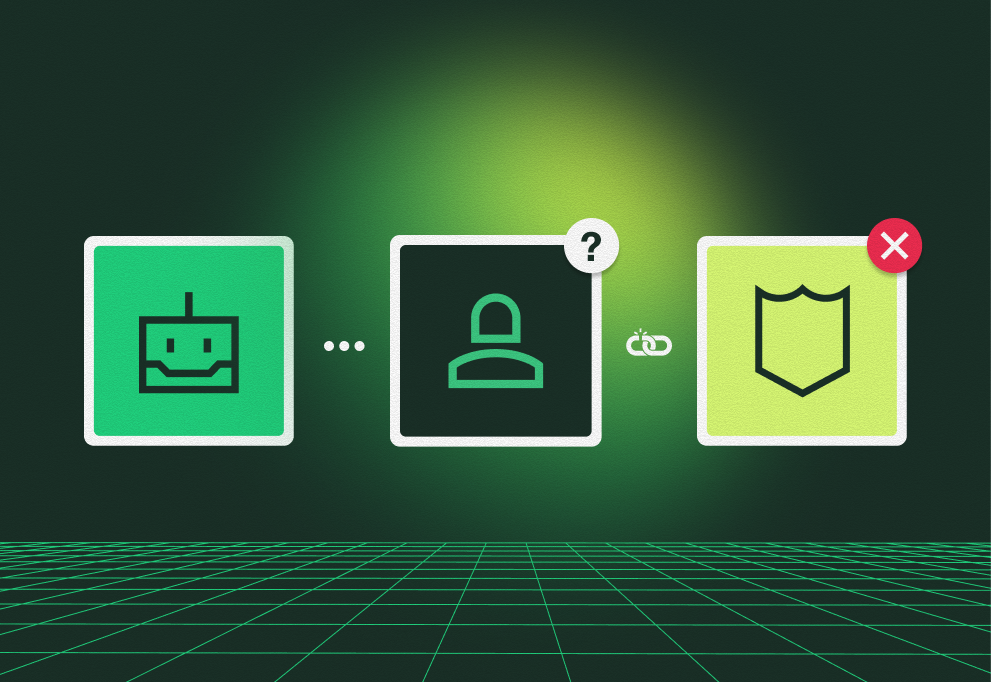


AI agents are evolving from experimental tools into independent actors operating at machine speed. This shift introduces significant and often overlooked security risk.
When organizations apply identity models built for static software and human users, security breaks down. Treating identity as a one-time configuration rather than a continuously enforced control allows AI agent risk to accumulate quietly and at scale.
Why AI Agent Security Breaks Under Configuration-Based Identity
Treating identity as a static setup task ignores how AI agent behavior changes over time.
Identity is still treated as a setup task instead of a control system
Identity for AI agents is typically configured at deployment. But unlike static applications, agents evolve, integrate with new systems, and act autonomously long after initial setup.
Configuration assumptions fail in autonomous environments
Configuration-based identity assumes predictable behavior, while autonomous agents adapt dynamically. Static identity models cannot keep pace with continuous change.
The security cost of static identity decisions
When identity decisions are frozen in time, risk accumulates silently. By the time an incident occurs, access no longer reflects actual agent behavior.
AI Agent Security Risks Created by Static Identity Configuration
When identity is static, AI agent security degrades as access expands without oversight, propagating risks.
Permissions granted upfront and never reassessed
Broad permissions granted at launch often persist long past their purpose, creating chronic over-privilege
Identity sprawl across agent frameworks and tools
As agents span APIs, SaaS, cloud services, and other agents, identity fragments across ecosystems and is rarely reconciled.
Invisible access paths created by agent chaining
When agents invoke other agents or tools, unintended access paths emerge that configuration alone won’t reveal.
Common AI Agent Security Challenges Security Teams Miss
AI agent failures are rarely isolated incidents. Instead, they reflect systemic identity control gaps.
Overprivileged Agent Identities
- Agents are launched with broad access that persists beyond their purpose.
- Least privilege is not continuously enforced.
Lack of Runtime Identity Awareness
- Security lacks real-time visibility into agent authorization decisions.
- Access occurs without clear intent context.
Configuration Drift and Policy Blind Spots
- Identity configurations lag behind evolving agent behavior.
- Policies exist without runtime enforcement
Agentic AI Security Risks Multiply Without Identity Context
Without identity contest, agentic AI security risks can spiral into disasters quickly.
Identity blind spots that amplify agentic AI risk.
Why Identity Must Be Treated as a Control Plane
Identity is the only layer that can evaluate intent at the moment of action.
It determines whether an action should occur under current conditions—not just whether access exists.
Security decisions must occur at runtime, not at deployment
In autonomous environments, access must be evaluated continuously as behavior, context, and risk change.
Governance must contract as well as expand access
Control planes reduce permissions automatically when risk shifts, preventing silent accumulation of excess access.
Adaptation is a security requirement, not an optimization
Static configurations preserve outdated assumptions; control planes govern live behavior.
Configuration-Based Identity vs Identity as a Control Plane
Identity Security as the Foundation of AI Agent Security
Identity control sits at the heart of AI agent security. AI agents become ungovernable the moment identity control is weakened.
Separating agent intent from authorization
Agents may request actions, but identity systems should decide whether those actions are permitted under current conditions.
Just-in-time access for agents
Access should be granted dynamically, only when needed, and only for the duration required.
Automatic revocation when risk changes
When behavior deviates, permissions should contract automatically, without waiting for human intervention.
How to Reframe AI Agent Security Around Identity
Effective AI agent security requires identity-first design. AI agent security ultimately rises or falls on identity control.
Designing agents with identity awareness from day one
Identity cannot be bolted on later. It must be embedded into agent architectures and decision loops from the start.
Embedding access governance into agent runtimes
Authorization should execute alongside agent logic, not outside it.
Measuring security based on access behavior, not configurations
What matters is how access is used, not how neatly it was configured.
What Security Leaders Must Change Now
To minimize security and compliance challenges, security leaders must rethink identity for AI agents.
- Stop treating identity as a deployment checklist: Identity is an operational system, not a box to tick.
- Shift security ownership closer to agent behavior: Security teams must monitor and govern runtime behavior, not just infrastructure.
- Prepare for regulatory scrutiny of autonomous access: Regulators will not accept “the agent did it” as an explanation for unauthorized access.
Conclusion: Configuration Is Static, Identity Must Be Dynamic
As AI technologies continue to proliferate in enterprise environments, AI agents will continue to rapidly outgrow static security assumptions. Security leaders must rethink identity and its relationship with agent behavior to minimize current and future risk
Frequently Asked Questions About AI Agent Security
What is AI agent security, and why does identity matter?
AI agent security governs how autonomous agents access systems and data. Identity matters because it controls intent, authorization, and accountability.
Why does configuration-based identity fail for AI agents?
Because agent behavior evolves over time while configurations remain static.
What are the biggest AI agent security challenges today?
Overprivileged identities, limited runtime visibility, and unmanaged agent-to-agent access.
How does identity as a control plane improve AI agent security?
It enables continuous evaluation, dynamic access enforcement, and automatic risk response.
What is the first step to securing AI agents with identity?
Stop treating identity as configuration and start treating it as an active control system.
Secure Every AI Agent.
From Creation to Runtime.