What is the risk of over-privileged AI agents?



The thing that makes agents powerful is the same thing that makes over-privilege
dangerous: they act.
A human with too much access is still bounded by attention, work hours, and friction. They
have to decide to do something, navigate a UI, and leave a log entry tied to their identity. An
agent with too much access acts autonomously, continuously, across dozens of tool calls
in seconds, and in most enterprise deployments today, under a shared service account
that tells your audit log nothing useful about what actually happened.
That's the core problem. Not just too much access. Autonomous reach with no attribution.
What over-privileged actually looks like
Most agents in enterprise environments don't have their own identity. They inherit one. A service account, an application's API credentials, a user's delegated token. That identity was provisioned for the application, not the agent. Permissions accumulated over time as integrations got added. Nobody scoped them down as the agent's actual task set narrowed.
OWASP names this the attribution gap in ASI03, Identity and Privilege Abuse, third on the Agentic AI Top 10. Agents borrow credentials, inherit permissions, reuse cached tokens from previous sessions, and carry all of that authority into every task they run. Compromise one agent, or get its goal hijacked via prompt injection, and you inherit everything it can reach.
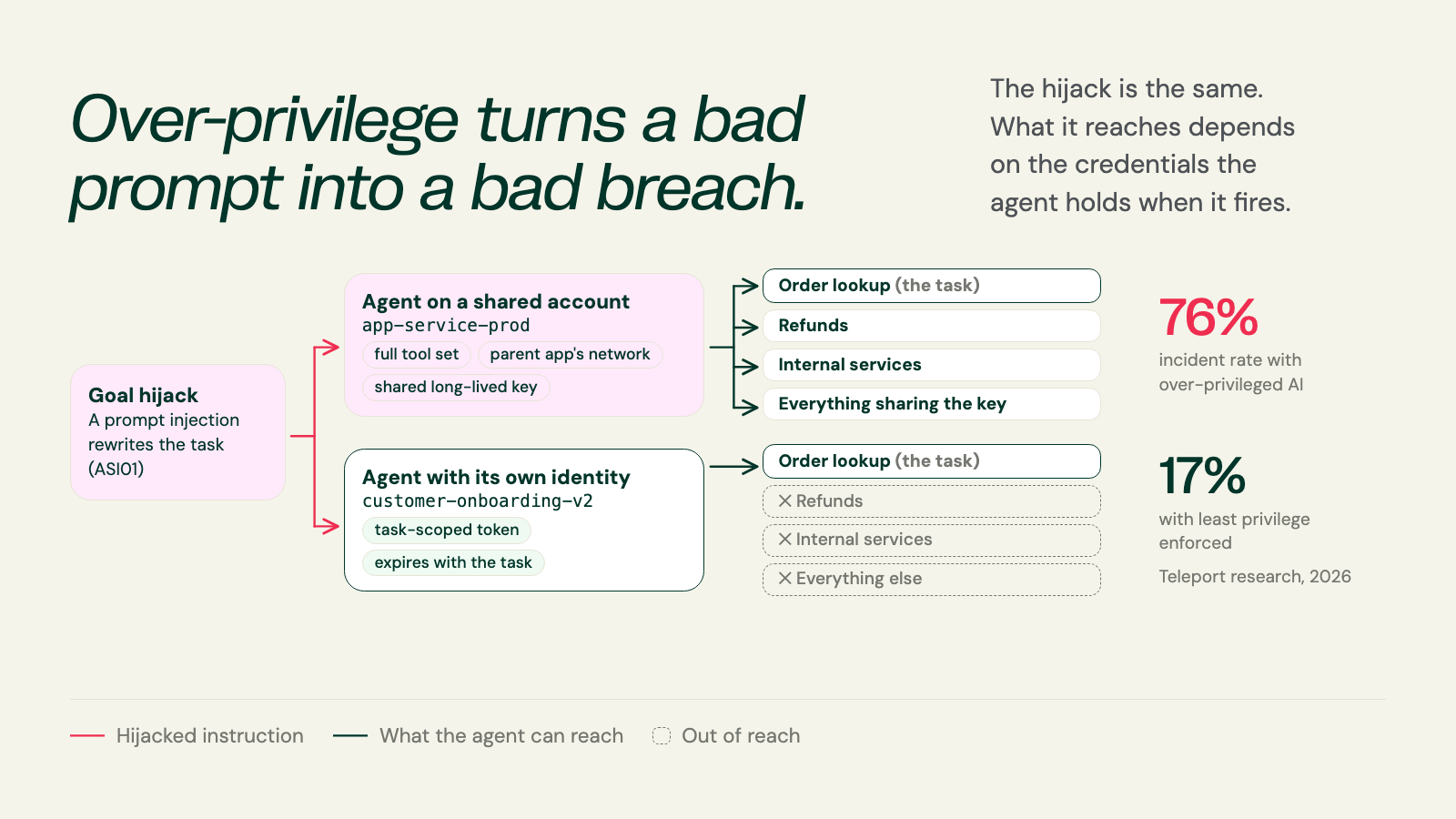
That compounds everything else. ASI01 (Goal Hijack) and ASI02 (Tool Misuse) are only as damaging as the credentials the agent holds when they fire. Over-privilege is the blast radius multiplier. It's what turns a bad prompt into a bad breach.
The numbers back this up. Teleport's 2026 research found organizations with over-privileged AI systems had a 76% incident rate, vs. 17% for organizations enforcing least-privilege. The average AI agent breach now costs $4.7 million. Around 90% of agents in production today hold excessive privileges. Only 21% of organizations have a program to govern agent access. Everyone else is running on inherited credentials and optimism.
Where the excess actually lives
Start with the thing that makes agents fundamentally different from a microservice: they don't follow a fixed execution path. A microservice calls the same APIs in the same order every time. An agent might decide, based on a specific prompt or a reasoning path nobody anticipated, to invoke a tool it hasn't touched in a thousand previous runs. You can't audit for that ahead of time. You can't build a permission matrix around every possible branch. The only thing that works is enforcing boundaries that make unpredictable calls harmless regardless of where the agent goes.
That's the underlying problem. Here's where it shows up in practice.
Most orchestration frameworks grant agents their full tool set at initialization. The agent gets everything registered to it, whether the current task needs it or not. A customer service agent that sometimes issues refunds has that capability active during every routine order lookup. Nobody turned it off between tasks because the framework doesn't think that way.
Network policies tend to be inherited from the parent application. Agents can reach internal services the specific task has no business touching, not because anyone decided to grant that access, but because nobody decided to deny it. The application could reach it, so the agent can too.
API credentials follow the same pattern. Long-lived keys scoped to the application, shared across every agent running under it. One compromised key hands an attacker the full permission set of everything sharing it.
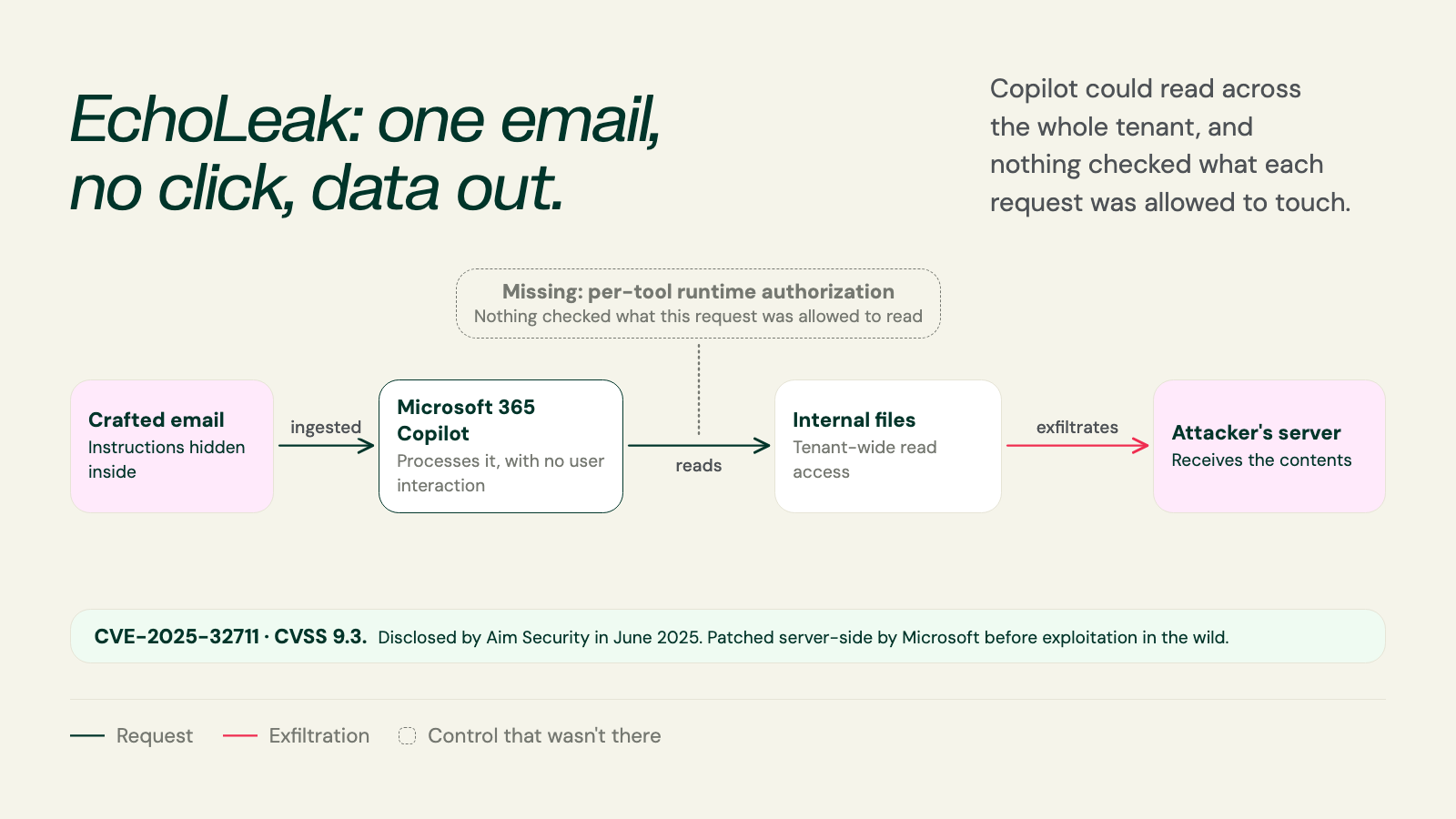
Take EchoLeak, a vulnerability disclosed in Microsoft 365 Copilot in June 2025 (CVE-2025-32711, CVSS 9.3). Researchers at Aim Security showed that a single crafted email, with no user interaction required, could get Copilot to read internal files and exfiltrate their contents to an attacker-controlled server. The flaw worked because Copilot inherited broad read permissions across the tenant with no per-tool runtime authorization checking what it was allowed to touch on a given request. Microsoft patched it server-side before it saw exploitation in the wild, but the mechanics are the blueprint: an agent with tenant-wide read access, no scoping, and no way to distinguish a legitimate instruction from one buried in a document it was asked to summarize.
The model that needs to change
The gap between left and right isn't a product purchase. It's an architectural decision about how agents get provisioned and what they're allowed to be.
What controlled access actually requires
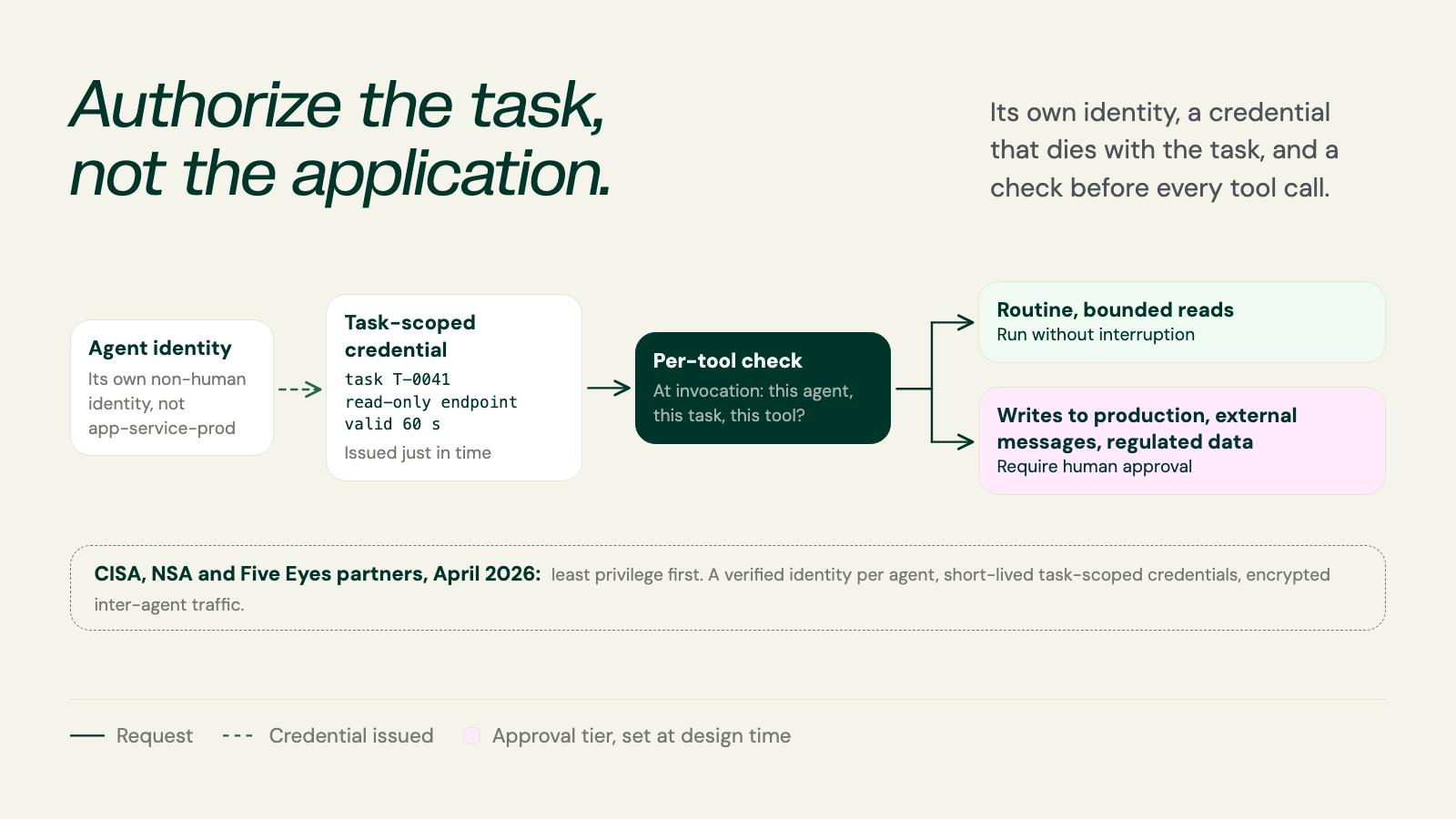
In April 2026, CISA and NSA released joint guidance with Five Eyes partners, "Careful Adoption of Agentic AI Services," putting least-privilege at the top of the agentic control set. Each agent should have a verified, cryptographically secured identity, short-lived credentials scoped to the specific task, and encrypted inter-agent communications. Privilege risk is listed first, ahead of design, behavioral, structural, and accountability concerns.
In practice, these controls matter most:
Agent identity. Each agent gets a non-human identity, its own managed credential, separate from service accounts and human users, with a scoped policy encoding what that specific agent is authorized to do. If your agents today authenticate as app-service-prod, you don't have agent identity. You have a shared credential your audit log can't distinguish from any other service call. For teams running agents in Kubernetes or cloud-native environments, SPIFFE/SPIRE or OIDC workload identity federation gets you the cryptographically verifiable, short-lived identity the guidance describes, without building a custom secrets distribution layer.
Task-scoped credentials. Credentials are issued just-in-time and expire when the task completes. Yes, this adds a handshake between the agent runtime and your IAM provider. The latency is milliseconds for a well-implemented JIT flow. The tradeoff is a hard ceiling on what a compromised or manipulated agent can reach. A token valid for "query this read-only endpoint for 60 seconds" cannot write to that database or touch an adjacent system, regardless of what the agent decides to do next.
Per-tool authorization at runtime. Tool access is declared at design time and enforced at invocation, before the call is made. The agent framework checks whether this specific agent, executing this specific task, is authorized to call this specific tool. Not after something goes wrong.
On human-in-the-loop: it's a real control, but it needs deliberate scoping. Requiring approval on every agent action eliminates the reason you built the agent. A risk-tiered trigger works better. Routine, bounded reads run without interruption. Writes to production, external communications, or access to regulated data classes require approval. You define the tier at design time and enforce it at the platform layer, not per run.
What this means in a regulated environment
In healthcare, the math is direct. An over-privileged agent with read/write access to a PHI data store, running under a shared service account, that gets goal-hijacked via prompt injection is a potential HIPAA breach, with no human making a bad decision anywhere in the chain.
There's also an audit problem that compliance teams tend to discover late. If your agent authenticates as a shared service account, your audit log shows that account, not the agent. When an auditor asks who accessed a specific record, "the application service account" is not an answer. Under HIPAA's Minimum Necessary standard and access logging requirements, you need to know which process accessed a record, under whose authority, for what purpose. The attribution gap is a security gap and a compliance gap at the same time.
The same pattern holds in financial services under SOX and PCI-DSS. Audit trail integrity is a hard requirement across regulated sectors, and shared agent identity breaks it consistently.
Where to start
Before you scope privileges, you need to know what agents you're running. That sounds obvious. It isn't, because a major and underestimated exposure in most environments is shadow agents: developers spinning up agentic workflows using personal API keys to move faster, outside any formal provisioning process. Those agents run with full user-level credentials, no scoping, no audit trail. Half the time, nobody knows they exist.
Start with one audit question this week: how many workloads in your environment are currently authenticating as a single high-privilege credential? Pull your service accounts with API key associations and count how many agentic workflows share them.
Scoped identity, JIT credentials, and per-tool authorization all follow from knowing what you're securing. You can't govern agents you haven't found.
Secure Every AI Agent.
From Creation to Runtime.