New Entitlements Inventory Helps Token Security Customers Understand and Control Access



Security and identity teams often ask the same simple question: who has access to what?
For human users, that question is already difficult. Permissions are fragmented, inconsistent, and constantly changing across cloud platforms, SaaS applications, identity providers, databases, collaboration tools, and custom applications. But as non-human identities (NHIs) and AI agents multiply across the enterprise, the problem becomes even more complex. A single agent might be connected to several backend identities. A service account might inherit access through a group. A role might grant permissions no one remembers assigning. A policy might look harmless until it is attached to the wrong principal.
The result is a growing blind spot that security and identity teams know access exists, but they do not always have a clear way to see what that access actually allows, who or what is using it, and whether it should still exist.
Introducing Entitlements Inventory
Today, Token Security is announcing Entitlements Inventory, a new feature that gives customers a severity-ranked inventory of their environment. Instead of forcing teams to chase permissions across identities, agents, groups, roles, policies, and applications, Entitlements Inventory brings them together in one place. While many competitors offer fragmented, single-cloud views, our differentiator is a unified, severity-ranked inventory spanning AWS, Azure, GCP, SaaS, and databases, allowing security and identity teams to understand and triage access at scale.
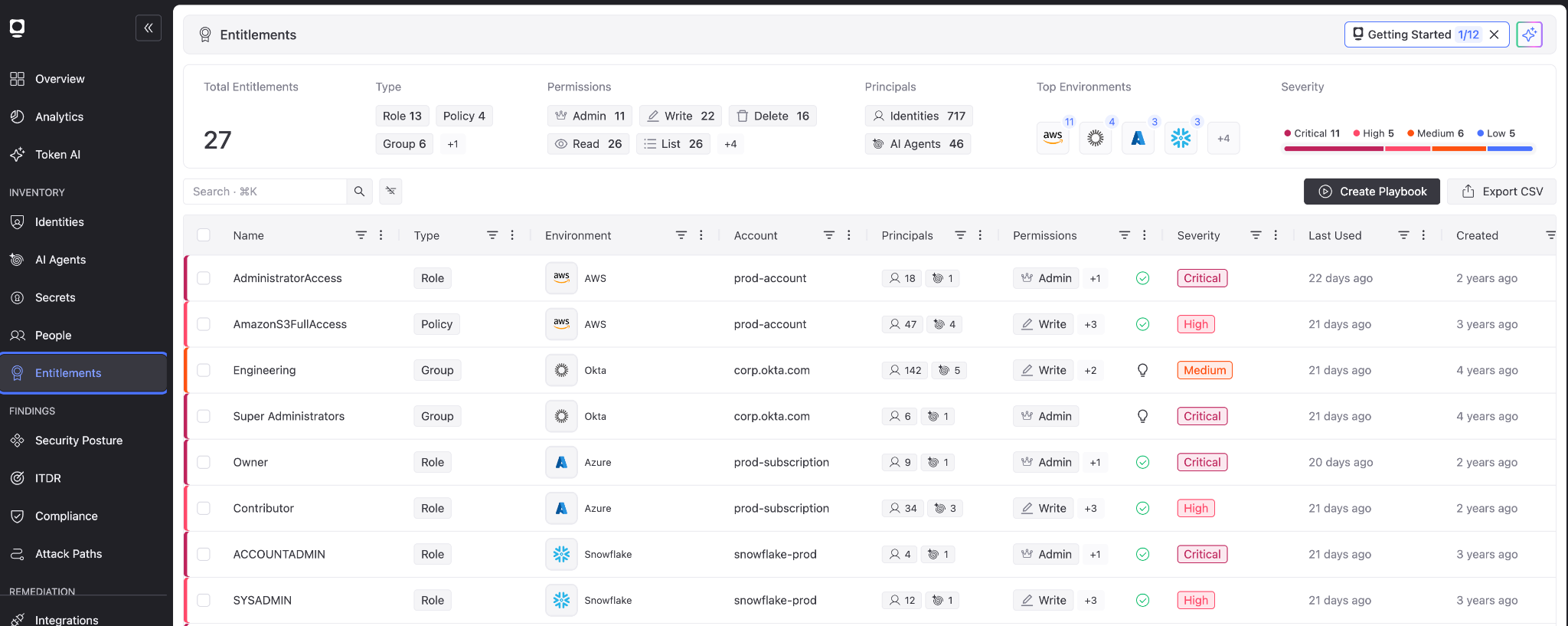
An entitlement is simple in concept: the ability to perform an action on a resource. In practice, it answers a critical security question: who can do what, and on what? That question matters more than ever.
A New Perspective on Access Control
Modern enterprises are built on layers of delegated access. A user belongs to a group. The group inherits a role. The role grants access to a cloud resource. An AI agent uses a connected identity. A service account can write to a database. A permission set enables administrative access. Each of these connections may be legitimate on its own, but together they create the real operating model of enterprise access. And that operating model is often invisible.
Traditional identity and access management tools can show pieces of the picture. Some provide a view of users. Others show permissions inside a single platform. Some can surface entitlements, but do not explain how those identities are actually being used, who owns them, or whether the access creates risk. Token Security’s identity-first approach was built to close that gap by connecting identities, permissions, usage, ownership, and blast radius across human identities, NHIs, and AI agents.
The Entitlements Inventory feature extends that approach by flipping the perspective. Instead of starting with an identity and asking what it can access, security and identity teams can now start with the permission itself.
With Entitlements Inventory, customers can see permissions such as roles, policies, groups, and permission sets in a single inventory. They can filter and search by entitlement type, environment, permission level, and consuming principals, including identities and AI agents. They can drill into a specific entitlement to understand what permissions it grants, which principals have access to it, and whether those permissions are being used.
For example, a team investigating broad cloud access can open an entitlement such as Amazon S3 Full Access and immediately see the permissions associated with it, the identities and agents connected to it, and signals that indicate whether certain permissions have not been used recently. If a user or agent has access to read, write, delete, and list resources, but has not used several of those permissions in the last 90 days, that becomes a clear opportunity to reduce risk by deleting or right-sizing permissions.
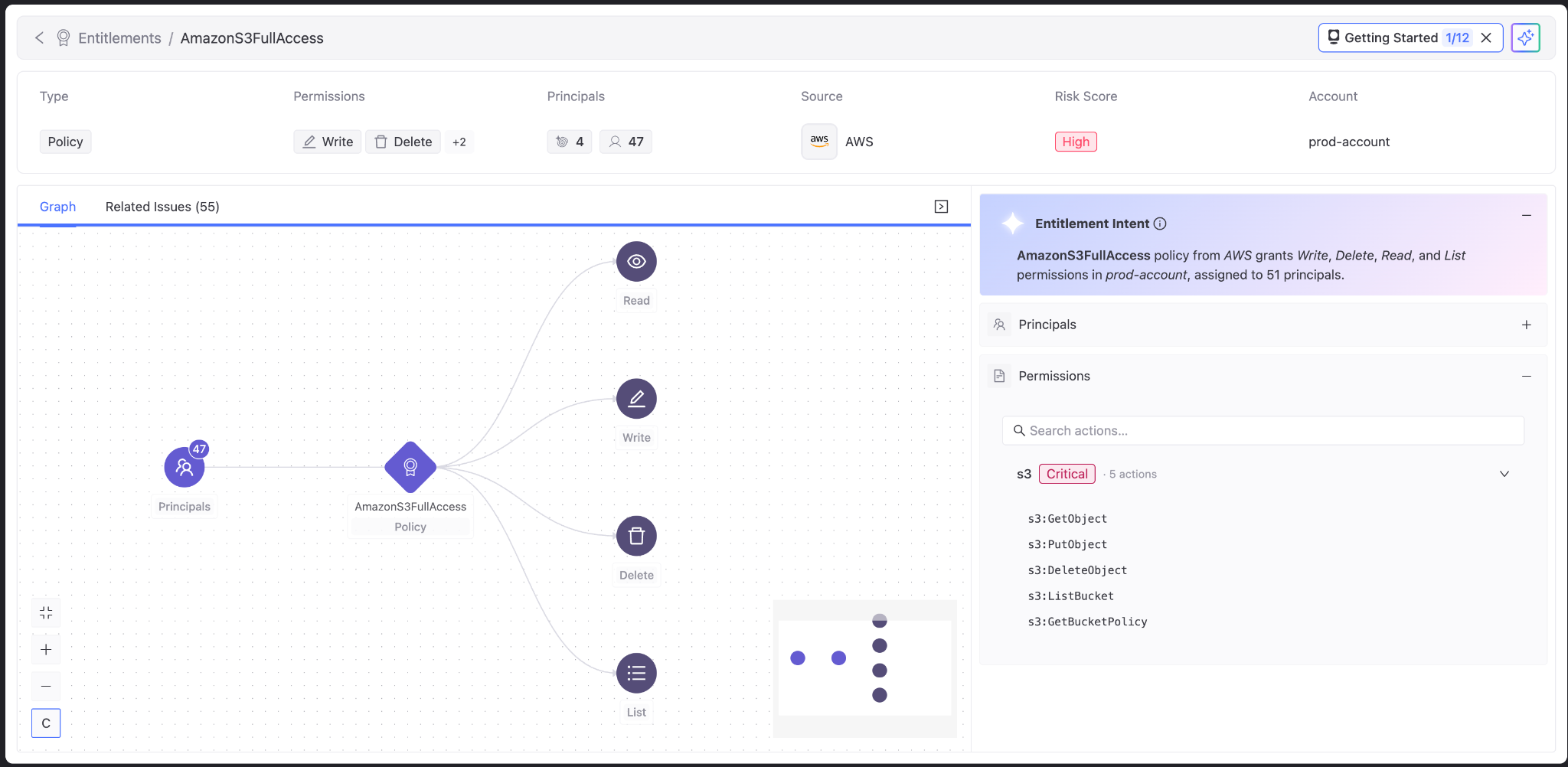
The Entitlements Inventory feature enables users to move beyond visibility and into action.
Surfacing Dormant Entitlements
Beyond typical policy misconfigurations, Entitlements Inventory helps teams identify dormant entitlements. These are permissions that grant administrative or sensitive access but are currently assigned to nobody. These represent a latent risk of forgotten access that could be easily exploited if rediscovered or improperly assigned. The Token Security platform helps teams proactively identify and clean up these risks.
Addressing Overpermissioning at Scale
Overpermissioning is one of the most persistent security problems in the enterprise. It is rarely caused by malicious intent. More often, it happens because teams are moving quickly, access is granted broadly to avoid blocking work, and permissions are then never revisited. Engineers end up with super admin access. Agents receive write privileges when they only need read access. Groups accumulate permissions over time and roles become dumping grounds for convenience.
For small environments, teams may be able to investigate these issues manually. For large enterprises with thousands or millions of entities, that approach does not scale. Security and identity teams need a severity-ranked inventory to see patterns, identify concentrations of risk, and prioritize remediation without clicking through every identity one by one. Every entitlement is assigned a risk level, allowing teams to triage the riskiest access first. The Entitlements Inventory feature now gives them that view.
Data Confidence and Clarity
It also gives teams confidence in the data behind the view. Token Security utilizes three levels of classification confidence: verified, inferred, and unknown. Verified entitlements are confirmed directly through integrations. Inferred intent is based on naming patterns, such as a group called "Super Administrators." Crucially, surfacing the "unknown" state is a deliberate choice to flag uncertainty to the user rather than making potentially dangerous assumptions. By distinguishing these levels of evidence, Token Security helps customers understand not only what we found, but the reliability of that determination.
The Value of Centralized Visibility
That distinction matters because no enterprise environment is perfectly documented. New services appear. New frameworks are adopted. Teams create new roles and groups. Permissions evolve faster than governance processes can keep up. Entitlements Inventory helps security and identity teams make sense of that complexity earlier, even when the underlying data is incomplete or inconsistent.
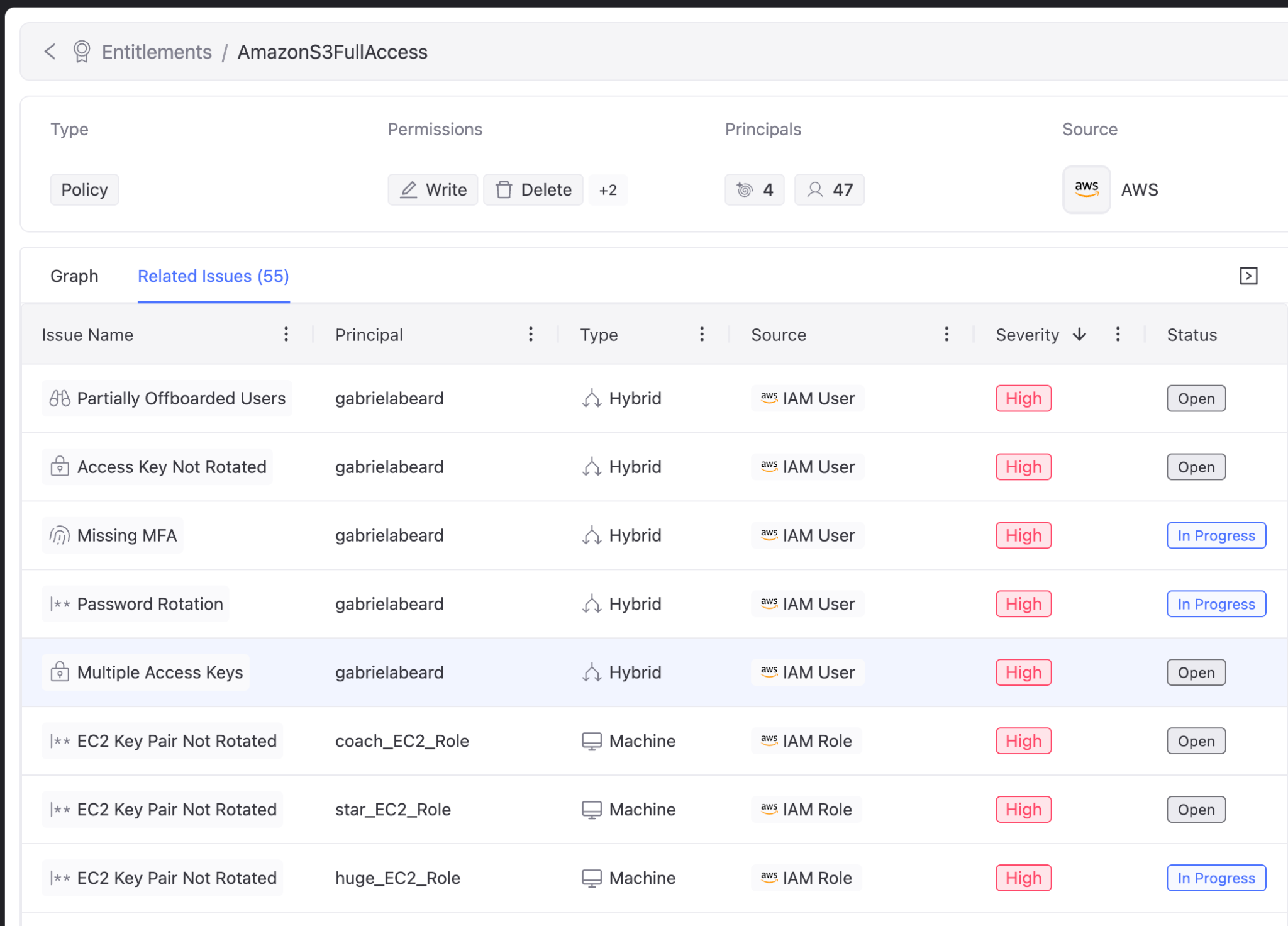
The value for our customers is immediate. Security and identity teams can now centralize permission visibility, investigate risky access faster, reduce overprivileged identities and agents, support least privilege initiatives, and build stronger foundations for compliance and remediation. When paired with Token Security’s broader platform capabilities, including ownership context, usage insights, risk analysis, and playbooks, entitlement visibility becomes part of a larger identity and access lifecycle.
Next Steps
First, discover what exists. Then understand what it allows, identify who or what has it, determine whether it is being used, prioritize what needs to change, and enable remediation through automated workflows.
The Entitlements Inventory feature is now available in the Token Security platform, giving customers a new way to understand permissions across identities, NHIs, and AI agents. It helps security and identity teams move from scattered access data to centralized insight, from manual investigation to scalable prioritization, and from broad assumptions to evidence-backed decisions.
To learn more about the new Entitlements Inventory feature, schedule a Token Security platform demo today.
Secure Every AI Agent.
From Creation to Runtime.