
Why Isolated Findings Aren’t Enough: Introducing Attack Path Analysis in the Token Security Platform




Security teams are drowning in findings. A leaked service account token. An over-permissioned IAM role. A CI/CD pipeline running with more access than it needs. A shadow AI agent with over-permissioned access. Each issue may be real, but when viewed in isolation you don’t get the full story.
Attackers do not think in isolated findings. They think in chains. One weakness leads to another, then another, until a compromised endpoint becomes a route to production data, cloud infrastructure, or administrative control.
That is the gap that Token Security’s new Attack Path feature is built to close.
The Problem: Findings Don’t Show Compounding Risk
Many security tools only identify individual issues. While they can tell you a credential is exposed or a role has excessive permissions, they often cannot show whether those issues connect and whether that connection creates a path an attacker can actually use.
Successful cyberattacks usually follow a sequence to gain initial access, pivot to a higher-privilege identity, assume a role, escalate permissions, and reach a high-value target. Each step may look manageable to security teams on its own, but together they can represent a critical breach path.
This challenge is even more urgent as environments adopt AI agents and other non-human identities. An AI agent with excessive permissions can move across systems at machine speed. It may not be malicious, but if it can access sensitive tools, secrets, or entitlements, the risk is real. Security teams need to move beyond asking, “What issues do we have?” to “What can an attacker actually do?”
How Token Security’s Attack Paths Feature Works
The new Attack Path analysis feature in the Token Security platform automatically discovers and visualizes multi-hop privilege escalation chains across identity and cloud infrastructure. By mapping relationships between identities, permissions, and resources across AWS, Azure, Okta, Entra ID, GitHub, and more, Token Security shows the routes an attacker could take from a starting point to a high-value destination.
At the core is a directed graph model that visualizes the potential attack path. Every node is an identity or resource an attacker can control. Every edge is an action they take. Token Security shows security teams exactly where to pinpoint and apply remediation to fix the most paths at once.
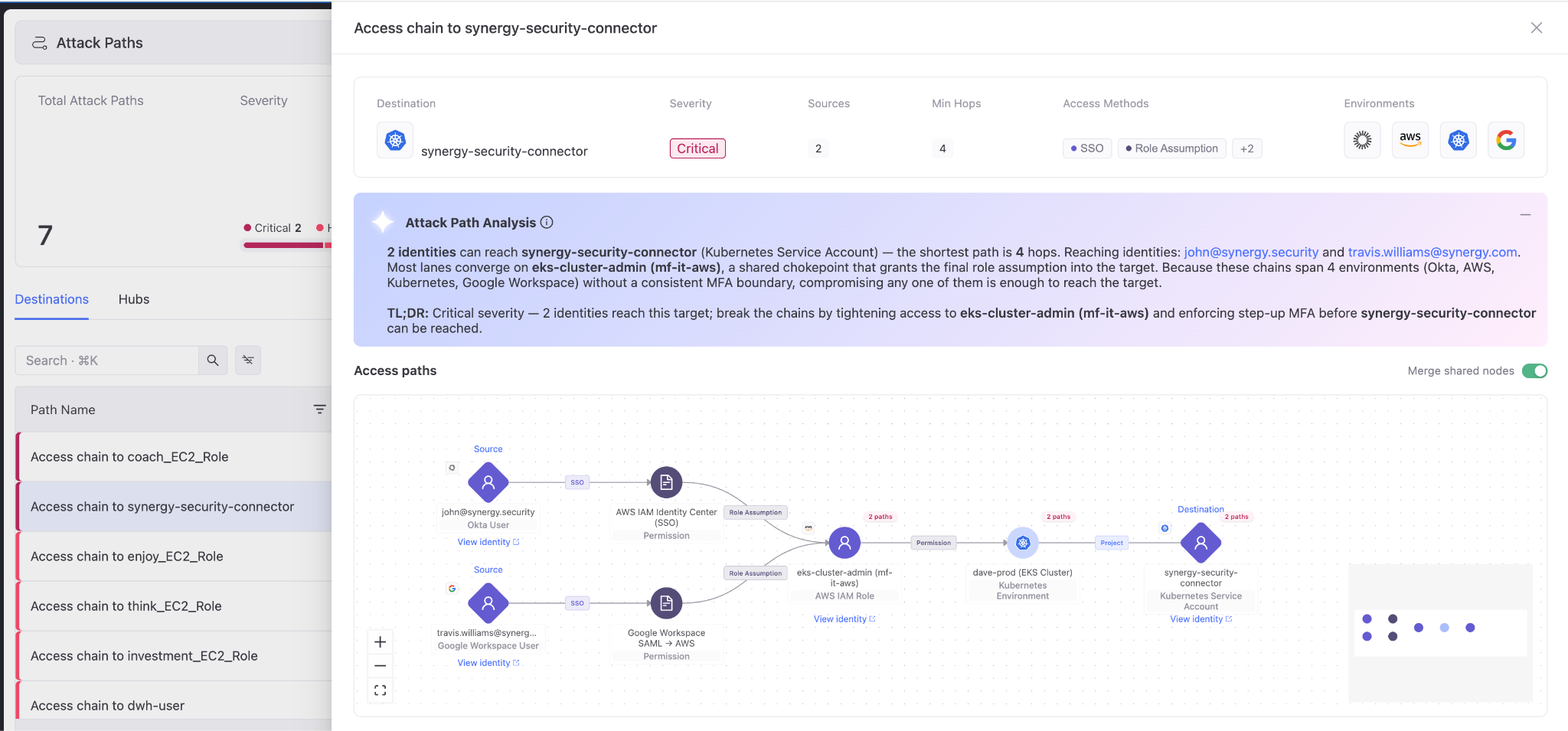
IAM roles, service principals, human users, AI agents, and GitHub apps are nodes. Actions such as federated SSO and cross-account role chaining are edges. Permissions and environments are not treated as extra hops. They are context attached to identities and actions, which keeps the attack path clear and accurate.
Discovery at Scale
Finding meaningful attack paths across a large organization is difficult. In an environment with thousands of identities and roles, there may be billions of theoretical paths. Token Security focuses on the paths that matter. To cut through the noise and determine attack path scenarios, the Token Security platform traces IAM assume-role and federation chains and flags dangerous permission combinations
The result is not a flood of theoretical possibilities, but a prioritized view of exploitable risk, based on real entry points, real permissions, and real high-value targets.
Prioritizing by Business Impact
Each attack path receives a severity score based on business impact. Token Security considers the criticality of the destination, the risk level of the source identity, whether administrative access is involved, and whether existing findings make the path exploitable.
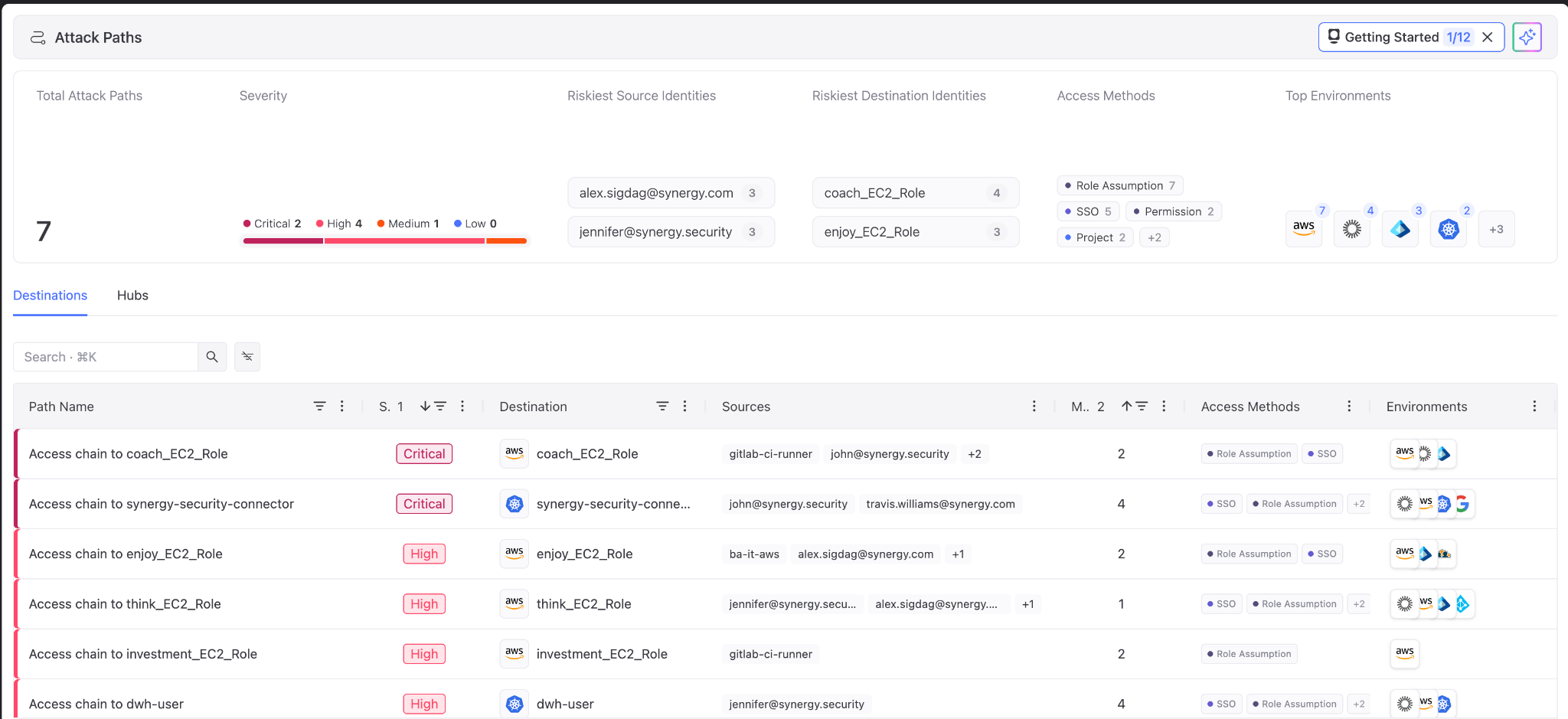
Critical paths combine a reachable starting point, a damaging endpoint, and a plausible route between them.
What Security Teams See in the Platform
In the Token Security platform, Attack Paths appear as a filtered, prioritized table of discovered chains. Teams can see the source identity, destination resource, severity, number of hops, and environments involved. A stats bar summarizes risk at a glance, including total paths by severity and the identities that most often appear as dangerous starting points or critical targets.
Selecting a path opens a graph view showing the full chain. Each identity node is labeled by type and environment. Each edge shows the attacker action it represents. Sidebar details expose the findings that make each hop exploitable, such as unrotated credentials, excessive permissions, or missing MFA.
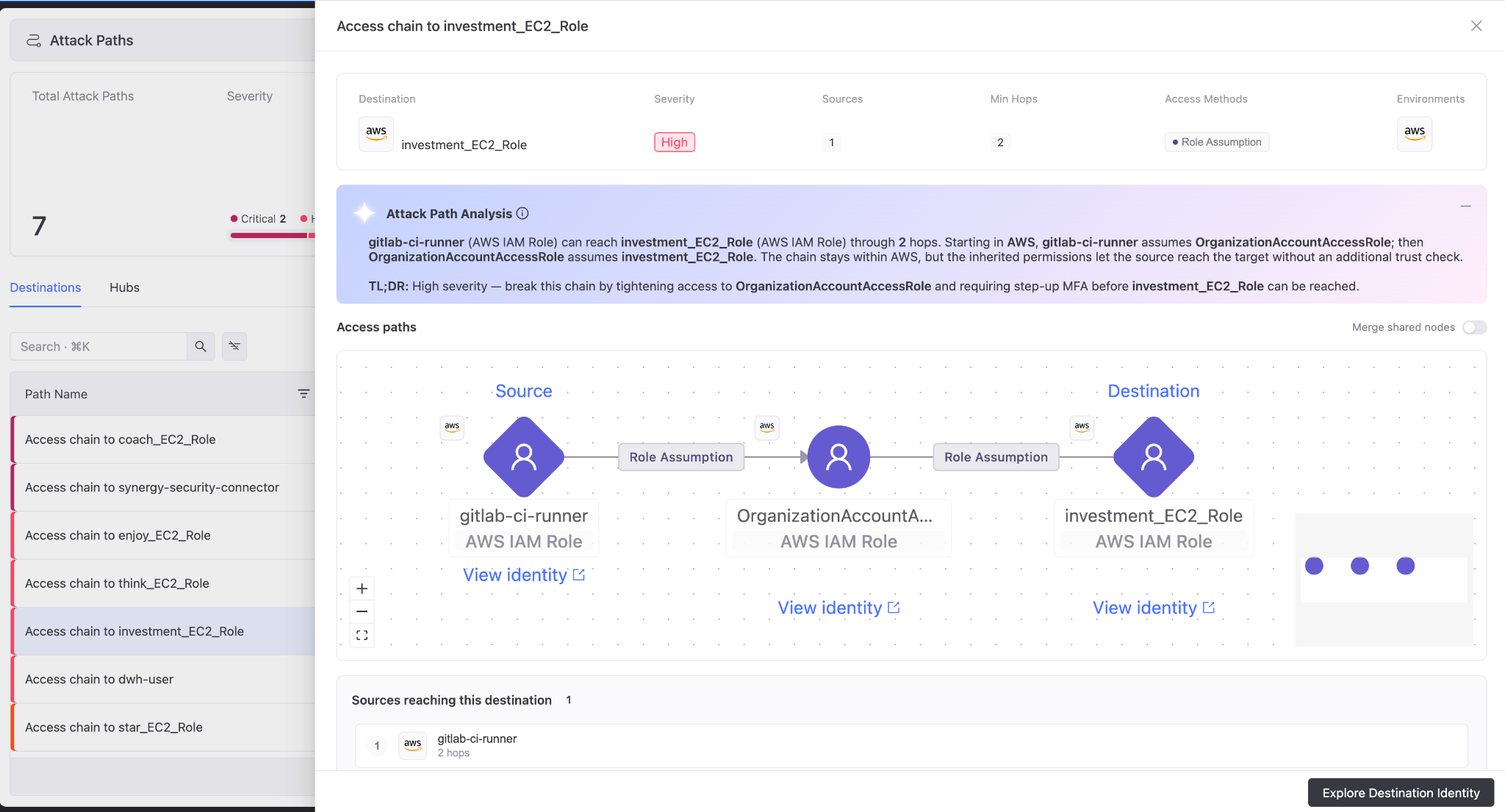
This view is useful beyond the security operations team as it turns complex technical risk into a narrative that security leaders, compliance teams, and auditors can understand.
From Reactive Findings to Proactive Remediation
Attack paths change how security teams can prioritize remediation to improve overall security posture. Instead of working through isolated findings one by one, teams now can ask, “Which fix mitigates the most attack paths at once?” This is a more efficient and defensible way to reduce risk across the enterprise.
Token Security’s Attack Path feature connects entitlements, findings, and identity relationships into a map of organizational exposure. For security teams, it means fewer surprises. For compliance teams, it means documented evidence of what existed, what changed, and when. For leadership, it means clearer answers to the questions that matter most, “what can an attacker actually do?” and “how do we take preventive action to stop them?”
To learn more about Token Security’s new Attack Path feature, request a demo.
Secure Every AI Agent.
From Creation to Runtime.